
Decking used to be a fairly simple choice: pressure-treated lumber for economy, cedar or redwood for appearance, and tropical hardwood for a premium finish. That decision is now tied to a wider construction question. The surface board affects maintenance, detailing, heat, fasteners, drainage, replacement cycles, and even how a deck connects visually to the rest of the house.
That is why products such as composite cladding belong in the same conversation as decking. Homeowners are no longer choosing isolated boards; they are choosing exterior material systems that may continue across walls, fascias, privacy screens, stairs, and outdoor rooms.
The important qualification is easy to miss: a more advanced board does not make a poorly designed deck safe or durable. The frame, ledger connection, flashing, slope, ventilation, and installation method still do most of the hidden work.
Table of Contents
- The surface is no longer the whole deck
- What has changed in the material mix
- How new decking changes construction
- A practical material comparison
- How to choose without chasing a trend
- Frequently Asked Questions
The surface is no longer the whole deck
The most visible change is the shift from a board-only purchase to a coordinated outdoor assembly. Manufacturers now commonly pair decking with matching fascia, stair nosings, railings, lighting channels, clips, and trim. This can produce cleaner lines, but it also means that a small change in board thickness or fastening method can affect stairs, guard details, door thresholds, and the finished height at the house.
Construction teams also have to think more carefully about movement. Solid wood changes dimension as its moisture content changes. Composite and PVC boards respond differently to heat and moisture, and their expansion rules depend on the product. A hidden-fastener system that works for one profile may not work for another. The result is a more controlled-looking finish, but fewer opportunities to improvise on site.
Modern decking has therefore made specification more important, not less. A builder should have the installation instructions, span tables, approved fasteners, edge-clearance rules, and warranty conditions before framing begins.
What has changed in the material mix
Wood remains attractive because it is easy to cut, familiar to builders, and visually forgiving. It can also be repaired or refinished in ways that are difficult with a capped composite board. Its weaknesses are equally familiar: it can absorb water, support decay when it stays wet, move with seasonal conditions, and require recurring cleaning, staining, or sealing.
Wood-plastic composite, usually called WPC or composite decking, combines wood fiber with a polymer matrix. The newer generation often adds a protective outer layer, more realistic grain patterns, lighter colors, and boards designed for hidden fastening. These products reduce some routine maintenance, but they are not immune to moisture or heat. Research summarized by the U.S. Forest Products Laboratory describes how moisture-driven expansion in the wood component can create microcracks in the plastic matrix over time, allowing fungal access under some conditions.
PVC decking removes the wood fiber and uses a largely polymer-based board. That can improve resistance to rot and reduce the risk of splinters, but it does not eliminate thermal movement, surface heating, or the need to design the frame correctly. Aluminum is another specialist option. It is dimensionally stable, noncombustible, and light for its strength, although it has a different appearance, sound, and thermal feel from wood.
Modified wood occupies a middle ground. Heat-treated or chemically modified timber can offer greater dimensional stability than untreated wood while retaining a natural surface. It should still be treated as a wood product during detailing: the substructure must dry, cuts may need protection, and the specified fasteners matter.
- Composite: useful where lower routine maintenance and a consistent appearance matter.
- PVC: useful where wood fiber, rot, or splintering is a particular concern.
- Aluminum: useful for demanding fire, moisture, or dimensional-stability requirements.
- Modified wood: useful where a natural appearance is important but ordinary timber movement is a concern.
How new decking changes construction
Moisture management becomes a design task
The most consequential change is not the appearance of the board. It is the attention required below it. A deck can fail while its top surface still looks acceptable if water is trapped around joists, ledger connections, post bases, or penetrations through the building envelope.
The Forest Products Laboratory’s guide to durable balconies and decks identifies three basic principles for reducing moisture-related risk: slope the walking surface, provide flashing and drainage, and allow the substructure to ventilate and dry. Those principles apply whether the visible boards are timber, composite, PVC, or aluminum.
Modern boards can make drainage more complicated. Narrow gaps, perimeter picture framing, fascia details, and solid skirting may look polished while restricting airflow. A builder may need to coordinate joist tape, drainage mats, sleepers, membrane protection, and access panels before the surface is closed.
Fasteners and spans are no longer interchangeable
Composite and plastic boards are not simply wood boards with a different finish. Their stiffness, screw-holding behavior, thermal movement, and permitted joist spacing can differ substantially. A local deck guide from Howard County, Maryland, notes that wood-plastic composites must meet specified performance criteria and warns that some composite members do not have the same capacity as equivalent wood sizes.
That has a practical consequence: a builder should not assume that a deck framed for one product can accept another product without checking the new manufacturer’s requirements. The same caution applies to stair treads, cantilevered edges, picture frames, and areas carrying concentrated furniture loads.
A practical material comparison
The table below is a screening tool, not a substitute for product documentation. The most important thing to notice is that every material has a different failure mode. Choosing a board only for its advertised maintenance level leaves out the conditions that actually shorten a deck’s life.
| Material | Typical strengths | Construction issues to check | Where it can disappoint |
|---|---|---|---|
| Pressure-treated or naturally durable wood | Familiar installation, easy cutting, repairable surface, natural appearance | Moisture clearance, treatment level, compatible fasteners, regular finishing | Rot, checking, warping, splinters, and recurring maintenance |
| Wood-plastic composite | Consistent color and profile, reduced routine coating, broad design range | Manufacturer span tables, thermal movement, approved clips, ventilation | Heat retention, surface fading, moisture-related damage within the composite |
| PVC decking | Low water absorption, no wood fiber, light weight in some systems | Expansion gaps, heat exposure, joist spacing, edge and stair details | Plastic appearance or feel, thermal movement, hot surfaces in direct sun |
| Aluminum | Dimensional stability, noncombustibility, resistance to rot and insects | Coating compatibility, slip resistance, sound, thermal bridging, drainage | Higher material cost, metal appearance, heat and noise concerns |
| Modified wood | Natural appearance with improved stability over some untreated timber | End-grain protection, compatible fasteners, ventilation, maintenance plan | Still requires wood-sensitive detailing and can be harder to source |
Source note: The comparison reflects the moisture, compatibility, performance, and installation considerations described in the U.S. Forest Products Laboratory deck guide and the Howard County typical deck details guide. Product formulations vary, so the manufacturer’s current technical documents control.
How to choose without chasing a trend
Start with the conditions at the site, not the color board. A shaded, damp deck beside a lake has a different problem from a south-facing rooftop terrace in a hot climate. A deck attached to an older house also has different constraints from a new-build terrace designed into the structure from the beginning.
A useful specification sequence is:
- Identify the exposure: sun, wind-driven rain, snow, salt air, wildfire risk, or persistent shade.
- Decide how much visible aging is acceptable. Timber can weather honestly; some composites are designed to hold a manufactured color.
- Check the complete assembly, including joists, ledger, flashing, drainage, railings, stairs, and door thresholds.
- Compare maintenance and replacement over the intended ownership period, not just the purchase price.
- Confirm that the board, clips, screws, and framing meet the local code and the product’s evaluation requirements.
Environmental comparisons deserve the same discipline. A U.S. Forest Service life-cycle assessment of redwood decking compared it with PVC and wood-plastic composite alternatives and found that results changed across impact categories. Its modeling also showed why the answer is not captured by the word “recycled” alone: material inputs, manufacturing energy, service life, transport, maintenance, and end-of-life treatment all affect the result.
My view is that durability is the best environmental strategy available to most homeowners, provided the material is actually suited to the site. Replacing a cheap deck twice can erase the apparent advantage of a low initial price. But a long warranty should not be treated as proof that a product is universally sustainable; it says little about the energy used to make it, whether it can be recycled locally, or how the supporting frame will perform.
What the next generation of decks will demand
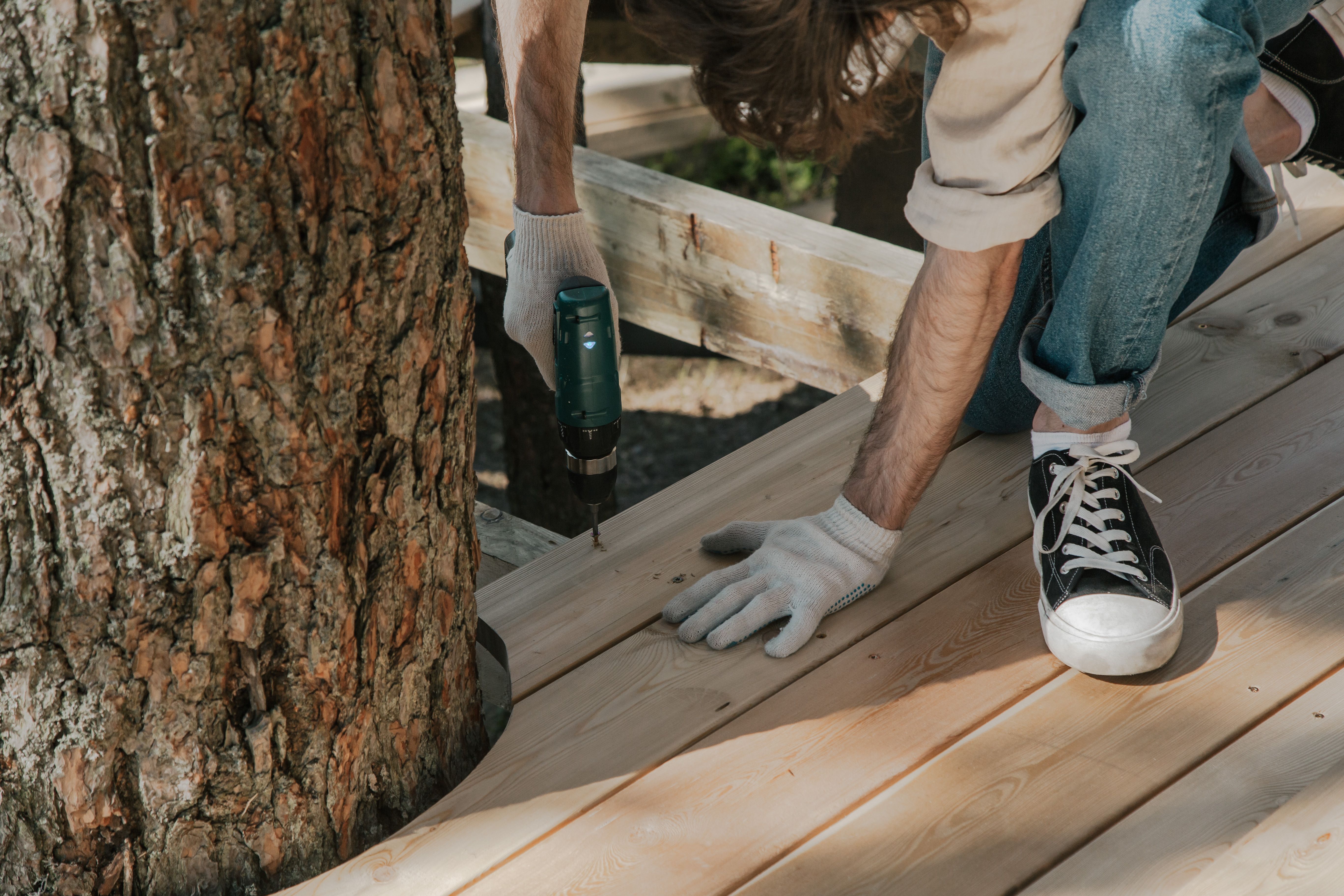
Residential construction is moving toward outdoor spaces that behave more like rooms. That means decking has to coordinate with shading, lighting, outdoor kitchens, drainage, planting, railings, and the house’s cladding. The board is becoming one component in a designed system rather than the final decision made after the frame is built.
That shift is positive when it encourages better detailing. It is risky when a sleek surface hides a wet substructure or when proprietary accessories make future repairs unnecessarily difficult. Homeowners should ask not only how the deck will look on installation day, but also how a damaged board will be replaced, where water will go after a storm, and which parts remain accessible.
The most modern deck is not necessarily the one with the newest polymer or the most convincing wood grain. It is the one whose material, structure, drainage, and maintenance plan agree with one another. That is the standard that will matter long after the product brochure has been discarded.
Frequently Asked Questions
1. Is composite decking stronger than wood?
Composite decking is not automatically stronger than wood. Its allowable spans, load capacity, screw-holding performance, and stair requirements depend on the product, so builders should use the manufacturer’s tested values rather than compare board names alone.
2. Does composite decking eliminate maintenance?
No. It can reduce staining, sealing, and painting compared with many wood decks, but it still needs cleaning, inspection, and attention to drainage. Boards can also fade, retain heat, or develop moisture-related problems if the assembly stays wet.
3. Which decking material is best for a hot, sunny location?
There is no universal winner. Light-colored products generally absorb less solar heat than dark ones, while the surface, ventilation, and shading design also matter. Ask for product-specific surface-temperature information if barefoot comfort is important.
4. Can new composite boards be installed on an old deck frame?
Sometimes, but only after the frame is inspected and the new product’s joist spacing, fastening, height, and drainage requirements are checked. An old frame may be sound yet still be unsuitable for a board with different spans or edge details.
5. Is recycled decking always the most sustainable choice?
Not necessarily. Recycled content can reduce demand for virgin material, but environmental performance also depends on manufacturing, transport, service life, maintenance, and end-of-life options. The most defensible choice is a durable product correctly installed for the site’s conditions.